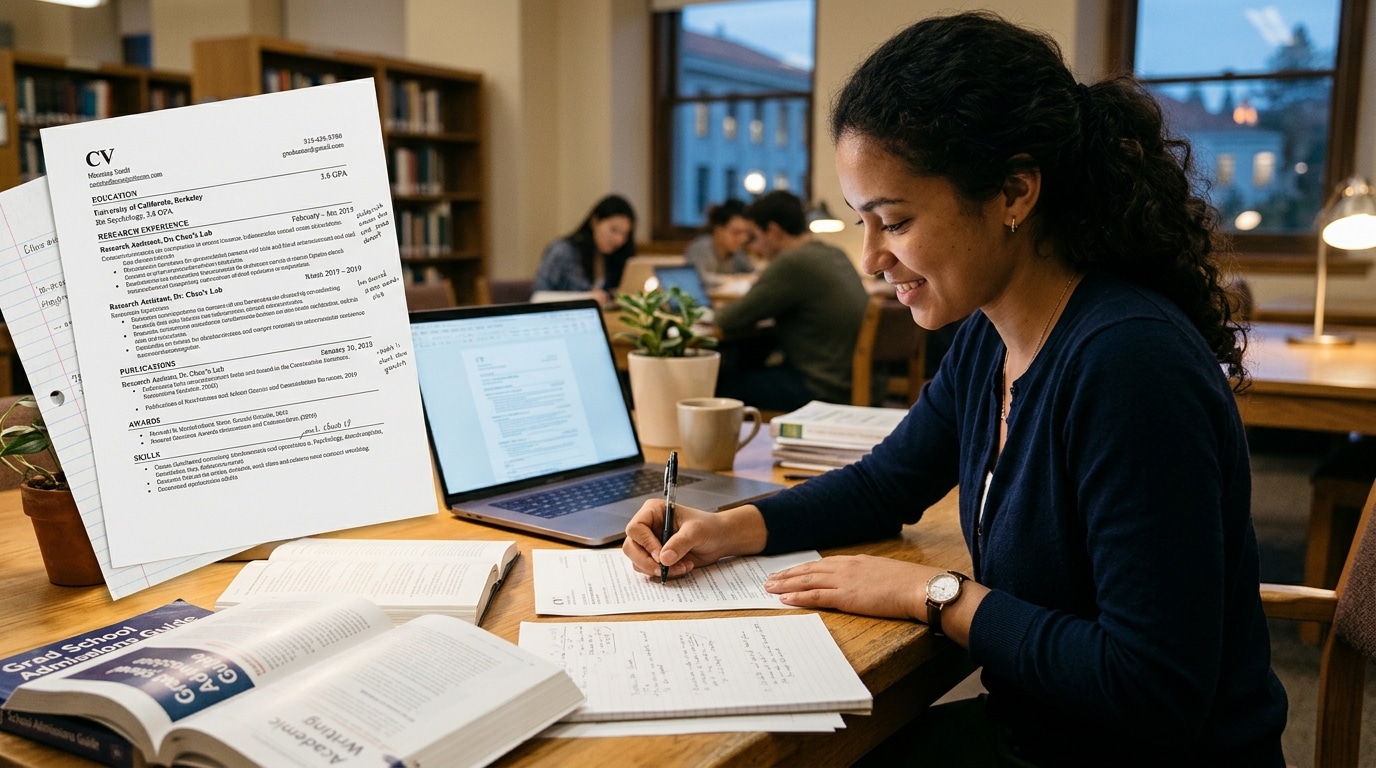
A grad school CV (curriculum vitae) is a clear record of your academic life: your education, research, publications, awards, teaching, and skills. For most applicants, it runs one to three pages, starts with education and research, and lists everything in reverse chronological order (newest first). Unlike a job resume, it is not about selling yourself in one page. It is about making the evidence easy for a faculty committee to find. This guide shows which sections to include, how to order and format them, and two example outlines you can adapt.
CV vs resume: which one does grad school want?
The two documents overlap, but they answer different questions.
| Academic CV | Resume | |
| Main question it answers | Can this person do graduate-level study and research? | Can this person do this job? |
| Typical length for applicants | 1 to 3 pages | 1 page, sometimes 2 |
| What comes first | Education and research | Work experience and skills |
| Includes publications, posters, teaching | Yes, in full | Rarely |
| Best for | PhD programs, research master’s, fellowships | Professional master’s, MBA, many industry-focused programs |
How to tell which one a program wants: read the upload field in the application portal. If it says “CV,” send a CV. If it says “resume,” send a resume. If it says “CV/resume,” choose by program type: a CV for PhD and research programs, a resume for professional programs. Also check for a page limit, which some programs set.
Applying to a professional master’s or an MBA? Our grad school resume guide covers that format.
What to include in a grad school CV (in order)
Use the sections below, in roughly this order. Leave out any section you have nothing for. An empty or padded heading looks worse than no heading.
1. Name and contact details
Your full name (larger than the rest of the text), a professional email address, phone number with country code, and city and country. Add a LinkedIn, GitHub, Google Scholar, or portfolio link if it shows relevant work.
For US and Canadian applications, leave out your photo, date of birth, marital status, and ID numbers. They are not expected and take up space.
2. Education
List each degree, newest first:
- Degree and major (for example, “B.Tech. in Mechanical Engineering”)
- University, city, country
- Dates (or “Expected May 2027”)
- GPA, if it helps you, on your university’s own scale (for example, “CGPA 8.6/10”). Don’t convert it yourself unless the program asks; the application form usually handles that.
- Thesis or capstone title and advisor, if you had one
You can add a short line of advanced coursework if it is directly relevant to the program. Skip high school unless you are very early in your studies.
3. Research experience
For PhD and research master’s applicants, this is often the most important section. For each project, give:
- Your role, the lab or group, the supervisor’s name, and dates
- Two to four bullet points: the question, your methods, and what came out of it
A weak bullet describes duties. A strong bullet shows what you did and what it produced:
- Weak: “Responsible for data analysis in the lab.”
- Strong: “Built a Python pipeline to clean and analyze 3 years of sensor data; results were used in the lab’s 2026 conference paper.”
Keep every claim accurate. Your recommenders and future advisors may read this, and they will notice exaggeration.
4. Publications, posters, and presentations
Use a consistent citation style from your field and bold your own name. Label status honestly: “published,” “accepted,” “under review,” or “in preparation.” Conference posters and talks at student research days count; list them in their own subsection if you have several.
5. Honors, awards, and scholarships
Include the award name, who gave it, and the year. Add a few words of context if the award isn’t well known outside your country (for example, “awarded to the top 1% of the graduating class”).
6. Teaching and mentoring
Teaching assistant roles, tutoring, and mentoring junior students all belong here. For PhD programs that fund students through teaching assistantships, this section quietly shows you can do the job.
7. Relevant work experience
Internships, industry jobs, and research-adjacent roles. Keep the focus on skills and results that connect to the program. A job in an unrelated field can still go here if it shows something useful, like managing a team or working with data.
8. Skills
Group them so they are easy to scan:
- Technical: programming languages, software, lab techniques, instruments
- Languages: each language with a plain proficiency level (native, fluent, intermediate)
List only skills you could discuss in an interview.
9. Service, leadership, and outreach (optional)
Student societies, conference volunteering, outreach programs, and community work. Keep it short unless the program values it highly, such as education or public health programs.
What to leave out
- Test scores: they usually go in the application form, not the CV.
- References: letters are submitted separately, so “References available on request” is not needed.
- Hobbies: leave them out unless one connects directly to the program.
How to format your CV
- Length: one to two pages for most master’s applicants; two to three for PhD applicants with research and publications. Never stretch it with spacing or large fonts.
- Font and layout: one readable font, 10.5 to 12 point, with clear section headings and normal margins. Skip graphics, photos, and complex columns.
- Dates: one format throughout (“Sep 2024 – May 2026”), aligned on the right.
- File: save as PDF with a clear name, such as “Firstname-Lastname-CV.pdf”.
- Proofread twice, then ask one person to read it on their phone. Many reviewers do.
Example CV outlines
These outlines show how the order changes with your profile. Replace each line with your own details.
Example 1: PhD applicant with research experience
- Name, email, phone, city, Google Scholar and GitHub links
- Education: B.S. in Computer Science, your university, 2022–2026, GPA, senior thesis title and advisor
- Research experience: two lab positions, each with supervisor, dates, and three results-focused bullets
- Publications and posters: one conference paper (under review), one student research day poster
- Honors and awards: department scholarship, undergraduate research grant
- Teaching: TA for an introductory programming course, two semesters
- Skills: programming languages, machine learning libraries, cluster computing
Example 2: Master’s applicant with little formal research
- Name, email, phone, city, portfolio link
- Education: B.A. in Economics, your university, 2019–2023, GPA, capstone project title
- Relevant projects: two course or independent projects, each with the question, tools used, and outcome
- Work experience: two years as an analyst, with bullets focused on data work and results
- Skills: statistics software, SQL, data visualization, languages
- Leadership and service: student finance society treasurer, volunteer data work for a nonprofit
Notice that Example 2 moves projects and work above skills. When you don’t have research to show, your strongest relevant evidence should still appear on page one.
No research experience? What to put instead
Many successful master’s applicants, and some PhD applicants, have no formal lab experience. Use what you do have:
- Course projects and capstones with a real question and method
- Independent study or a thesis, even an undergraduate one
- Technical work at a job, such as analysis, testing, or building tools
- Open-source contributions or public portfolios
- Short research programs, summer schools, or reading groups
Then use your statement of purpose to explain what you want to research and why. Our guide to writing a personal statement for graduate school shows how to connect your experience to your goals.
Tips for international applicants
- Follow North American conventions for US and Canadian programs: no photo or personal details, and reverse chronological order.
- Keep your grades on your home scale, and name the scale clearly (out of 10, out of 4, percentage, or class of degree).
- Give context for local names. Add a short description for awards, exams, or institutions an international committee may not know.
- Use the English name of your university as it appears on your transcript.
Applicants from many countries share how they handled this on the GradCafe forum.
Common grad school CV mistakes
- Sending a one-page job resume to a PhD program.
- Burying research under work experience or skills.
- Listing duties instead of results.
- Inflating publication status, such as calling a draft “submitted.”
- Mixing date formats, fonts, or bullet styles.
- Forgetting to update the CV you sent to recommenders. Give them your final version, along with your statement, so their letters can match it. Here’s how to ask a professor for a recommendation letter.
How your CV works with the rest of your application
Your CV is the evidence. Your statement of purpose tells the story behind it, and your letters confirm it. Committees often read them side by side, so make sure dates, project names, and titles match across all three. If you are emailing potential PhD advisors, attach your CV as a PDF; it answers most of their first questions.
With more programs now GRE-optional, your CV carries more of the weight in showing what you can do. See which programs dropped the test in our guide to GRE-optional grad programs for Fall 2027, and check your timing against the Fall 2027 deadlines guide.
Frequently asked questions
How long should a CV be for grad school?
One to two pages is typical for master’s applicants, and two to three pages for PhD applicants with research and publications. Follow any page limit the program sets.
Should I put my GPA on my grad school CV?
Include it if it helps you, on your university’s own scale. You will usually report it in the application form as well, so leaving it off the CV doesn’t hide it.
Do I need research experience to write a good grad school CV?
No. Course projects, a capstone, technical work, and independent study can show the same skills. Put your strongest relevant evidence near the top.
Is a CV the same as a resume for grad school?
No. A CV focuses on education, research, and academic work and can run several pages. A resume focuses on work experience and is usually one page. PhD programs typically want a CV; many professional programs want a resume.
Should I include references on my CV?
Usually not. Recommendation letters are submitted separately through the application portal, so a references section just takes up space.
Next steps
A clear CV takes an afternoon to draft and saves reviewers time, which always works in your favor. Write the first version this week, then share it with a mentor before your first deadline.
- Browse admissions results to see the profiles past applicants reported for your programs, or start from a school page such as Stanford, Carnegie Mellon, or the University of Toronto. Results are self-reported, so treat them as a guide.
- Ask for feedback on the forum.
- Submit your result when decisions arrive