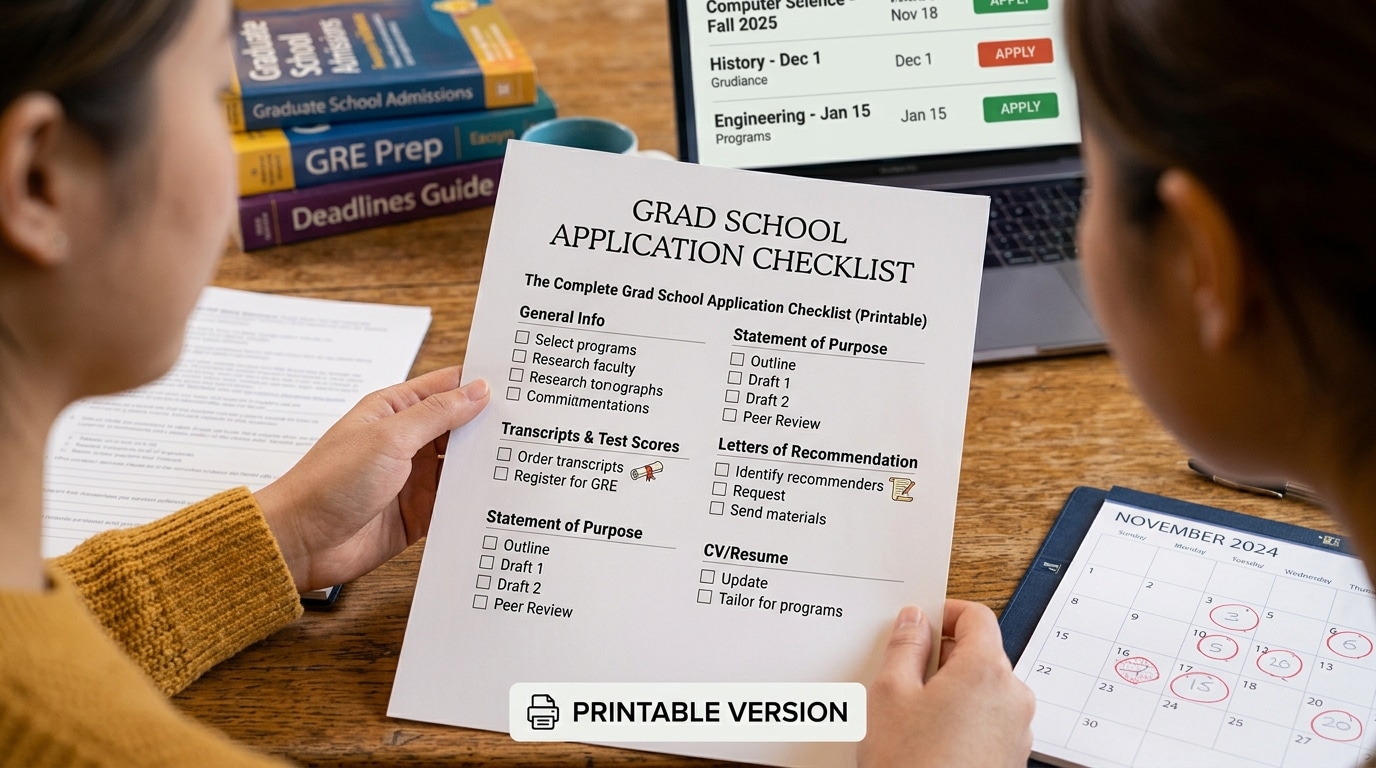
A grad school application has more moving parts than most people expect: a portal account, official transcripts, test scores sent by the testing agency, two or three letters uploaded by other people, a statement of purpose written for each program, a CV, a fee or a waiver, and sometimes a writing sample, portfolio, or interview. Miss one and the application sits incomplete, sometimes without anyone telling you.
This checklist puts every item in one place, in the order you should tackle them, for both master’s and PhD applications. Tick items off as you go, or download the printable version at the end and keep one copy per program.
Take this checklist with you
Print one copy per program and tick items off as you go, or save it as a PDF from the print dialog.
Requirements differ by program. Use this list as your master checklist, then add anything your specific program asks for.
The checklist at a glance
| Stage | What to finish | When (Fall 2027 cycle) |
| 1. Research and shortlist | Program list, deadlines, test policies, funding notes | By end of October 2026 |
| 2. Tests | GRE/GMAT if required; TOEFL/IELTS/Duolingo if required; scores sent | Book by October; scores in before December |
| 3. Transcripts and credentials | Official transcripts ordered; evaluations (WES etc.) if needed | Order in October |
| 4. Letters of recommendation | 3 recommenders asked, briefed, and reminded | Ask in October; remind 2 weeks before each deadline |
| 5. Written documents | Statement of purpose (per program), CV, writing sample or portfolio, diversity/personal statement if asked | Drafts by mid-November |
| 6. Portal and fees | Account created, forms filled, fee paid or waiver approved | Submit 48 hours before each deadline |
| 7. After you submit | Confirmations saved, letters confirmed, interviews prepped, decisions tracked | December onward |
The sections below walk through each stage.
Stage 1: Research and shortlist
- [ ] Decide on the degree. Master’s or PhD, thesis or professional, and whether you need funding to go. If you’re unsure how long each takes, read how long grad school takes.
- [ ] Build a program list of the right size. Our guide on how many grad schools you should apply to explains how to split reach, match, and likely programs.
- [ ] Write down every deadline with its time zone, and note whether it is a priority (funding) deadline or a final deadline. The Fall 2027 application deadlines tracker lists the common clusters month by month.
- [ ] Record each program’s test policy: required, optional, or not accepted. Policies change year to year, so check the current admissions page, not a forum post from two cycles ago.
- [ ] Note the funding picture: is admission tied to an assistantship or fellowship, and is there a separate funding application? What a fully funded PhD actually includes is a good benchmark.
- [ ] Identify two or three faculty per program (for PhDs and research master’s) whose current work you can name in your statement.
- [ ] Check past results. Search each program in the GradCafe results database to see what applicants reported about outcomes, decision dates, and interviews. Start with your field, for example Computer Science, Physics, or Economics. These reports are self-reported and self-selected, so treat them as a signal, not an official rate.
Stage 2: Standardized tests
Fewer programs require the GRE than five years ago, but “fewer” is not “none,” and international applicants almost always need an English test.
- [ ] Confirm which tests each program requires (GRE General, GRE Subject, GMAT, or none). If you’re deciding whether to sit the GRE at all, what counts as a good GRE score and what is on the GRE will help you judge.
- [ ] Book the test date early. Official scores take time to reach programs; how long it takes to get GRE scores explains the gap between test day and score delivery. Leave at least three to four weeks before your first deadline.
- [ ] English proficiency test (TOEFL, IELTS, or Duolingo English Test, depending on what the program accepts) if your prior degree was not taught in English. Check each program’s minimum score and whether it accepts your test. Some programs waive this for degrees completed in English-speaking countries; ask rather than assume.
- [ ] Send official scores to every program that needs them. Score sending is a separate step from taking the test, and each additional recipient usually carries a fee.
- [ ] Record your scores and send dates in your tracking sheet so you can confirm receipt later.
Stage 3: Transcripts and credentials
- [ ] Order official transcripts from every institution where you earned credit, including exchange semesters and transfer credits. Registrars can take two to four weeks; some only send paper copies.
- [ ] Check whether unofficial transcripts are accepted for review with official ones required only on admission. Many US programs work this way, which saves money.
- [ ] Credential evaluation (WES, ECE, or the evaluator the program names) if a program requires it for non-US degrees. This can take several weeks and needs documents sent directly from your university.
- [ ] Certified translations for any document not in English, if the program requires them.
- [ ] Degree certificate or proof of enrollment if you have not yet graduated. Most programs admit you conditionally and ask for the final transcript later.
- [ ] GPA conversion. If your grading scale is not a 4.0 scale, do not convert it yourself unless the portal asks you to; enter the original scale and let the program evaluate it. If your GPA is a worry, read how to get into grad school with a low GPA before you decide which programs to keep.
Stage 4: Letters of recommendation
Most programs ask for three letters; a few ask for two. This is the one part of the application you don’t control, so it goes early.
- [ ] Choose recommenders who know your academic or research work directly. For a PhD, at least two should be faculty who can speak to your research ability. For a professional master’s, a supervisor can be a strong third letter.
- [ ] Ask in October, in person or by email, with a clear deadline list. Our guide on how to ask a professor for a letter of recommendation includes templates.
- [ ] Send a brief packet to each recommender: your CV, your statement of purpose draft, the list of programs with deadlines, and a short reminder of the work you did with them.
- [ ] Enter recommender details in each portal as early as the portal allows, so the request emails go out well before deadlines.
- [ ] Decide whether to waive your right to view the letters. Most applicants waive; many faculty expect it.
- [ ] Send a polite reminder two weeks before each deadline, and check the portal’s letter status a week out.
- [ ] Thank your recommenders after submission and tell them your outcomes in the spring.
Stage 5: Written documents
Statement of purpose
- [ ] One tailored statement per program. Reuse the core, but each version should name the program, the faculty, and the specific reasons you fit there. How to write a personal statement for graduate school covers structure, length, and the mistakes committees see most.
- [ ] Check the prompt and length limit for each program. Some ask for 500 words, some for two pages, and some want a separate “personal history” or “diversity” statement.
- [ ] Get two rounds of feedback, ideally one from someone in your field and one from a clear-eyed reader outside it.
- [ ] Proofread the program name in every version. Sending Program A a statement that praises Program B is the most common avoidable error.
CV or résumé
- [ ] Academic CV for PhD and research master’s applications: education, research experience, publications and presentations, awards, teaching, relevant skills. Two pages is normal.
- [ ] Résumé for professional master’s programs, usually one to two pages focused on work experience.
- [ ] Match dates and titles to your transcript and your recommenders’ knowledge of you.
Field-specific extras
- [ ] Writing sample for humanities, social sciences, and law-adjacent programs: usually a polished seminar paper within the stated page limit. Search Creative Writing or Philosophy results to see what applicants in those fields reported alongside their outcomes.
- [ ] Portfolio for MFA, architecture, and design programs, in the file format and size the program specifies.
- [ ] Research proposal for many UK, European, and Australian PhDs, and some Canadian programs.
- [ ] Supplementary questions in the portal (short answers about research interests, faculty choices, or funding) that are easy to overlook until deadline day.
Stage 6: The portal, fees, and submission
- [ ] Create an account on each application portal as soon as it opens, usually September or October. You can see every required field before you start writing.
- [ ] Fill in the biographical and academic sections early. They take longer than you expect, especially listing every course for programs that ask.
- [ ] Upload documents in the required format (usually PDF) and check that each one opened correctly after upload.
- [ ] Application fee, typically paid by card in the portal. Fees vary by school; check each one.
- [ ] Fee waiver, if you qualify. Waiver deadlines are often earlier than application deadlines and sometimes require a separate form, so handle this in October or November.
- [ ] Select your faculty of interest where the portal asks. Some departments route applications to reviewers based on this choice.
- [ ] Submit at least 48 hours early. Portals slow down on deadline day and support desks close over the December holidays.
- [ ] Save the confirmation email and a PDF of the submitted application for every program.
Stage 7: After you submit
- [ ] Confirm every letter arrived by checking the portal status a few days after submission, and nudge recommenders if one is missing.
- [ ] Confirm test scores and transcripts were matched to your application. Mismatched names or dates of birth are a common reason scores show as “not received.”
- [ ] Prepare for interviews if your field has them. How to prepare for a graduate school interview covers common questions and format. Check the results database to see whether past applicants to your program reported an interview stage.
- [ ] Know the timeline. Most PhD decisions arrive between late January and March, with April 15 the common response deadline for funded offers at US schools. What happens after you apply to grad school explains the review process in between.
- [ ] Track decisions as they go out by searching your program in the GradCafe results database. When your own decisions arrive, add your result so other applicants can see the timeline too.
- [ ] Keep your email and phone current in every portal. Waitlist movement after April 15 is fast, and programs contact the details on file.
International applicants: extra items
- [ ] Passport valid well beyond your intended start date; some portals ask for the number at application.
- [ ] English test score meeting each program’s minimum, sent officially.
- [ ] Credential evaluation and translations (Stage 3), started early because they take weeks.
- [ ] Proof of funds is usually requested after admission for the visa, not at application, but know what your target country requires so you aren’t surprised in April.
- [ ] Earlier deadlines. Some programs set an earlier date for international applicants or for funding consideration; check each page.
- [ ] Visa timeline. Once you accept an offer, the I-20, CAS, or study permit process starts, and summer appointment slots fill quickly. Country-specific threads on the GradCafe forum are the fastest way to learn what applicants from your country ran into last year.
Your tracking sheet
Keep one row per program with these columns: program, degree, deadline and time zone, priority vs final, test policy, scores sent (date), transcripts sent (date), recommenders 1–3 (requested / submitted), statement of purpose (drafted / final), CV, extras (writing sample, portfolio, proposal), fee paid or waiver status, submitted (date), confirmation saved, interview, decision, decision date.
Download the printable checklist and print one page per program, or copy the columns above into your own spreadsheet.
Take this checklist with you
Print one copy per program and tick items off as you go, or save it as a PDF from the print dialog.
Frequently asked questions
What documents do you need to apply to grad school?
Most programs require official transcripts, a statement of purpose, a CV or résumé, two or three letters of recommendation, and an application fee. Many also require GRE or GMAT scores, an English proficiency test for international applicants, and field-specific extras such as a writing sample, portfolio, or research proposal. Always check the program’s own requirements page.
When should I start my grad school application?
For Fall 2027 admission, start your shortlist and recommender requests by October 2026, finish test and transcript steps the same month, and have written documents drafted by mid-November, since many PhD deadlines fall on December 1 and December 15. If you are reading this later than that, use the checklist to find what you can still complete and prioritize programs with January and February deadlines.
How many letters of recommendation do you need for grad school?
Three is the standard for most PhD and master’s programs; a few professional programs ask for two. At least two should come from faculty who can speak to your academic work, especially for research degrees.
Do I need the GRE to apply to grad school in 2027?
It depends on the program. Many programs are now GRE-optional or do not accept scores, but some, especially in certain STEM and economics programs, still require it. Check each program’s current admissions page rather than relying on last year’s policy.
What should I do after submitting my grad school application?
Confirm that letters, scores, and transcripts were received, prepare for interviews if your field holds them, and track decision timelines for your program in the GradCafe results database. Keep your contact details updated in every portal.
Next steps
Print the checklist, start with the items other people control (letters, transcripts, test scores), and work backward from your first deadline.
- Search past results for your programs
- See every Fall 2027 deadline month by month
- Decide how many programs to apply to
- Join the Fall 2027 applicants discussion
- Submit your result when decisions arrive