
An online EdD (Doctor of Education) lets you earn a doctorate in education while you keep working. Most programs on this list are built for teachers, principals, and other education leaders, take about three to four years, and end in an applied dissertation or capstone project instead of a traditional thesis.
Below, we compare 10 online doctoral programs in education by credits, length, campus visits, test requirements, and cost, so you can shortlist the ones that fit your job and your budget. Every detail was checked against the university’s own pages in October 2026.
Not sure whether you need an EdD or a PhD in education? Jump to Online EdD vs. online PhD in education.
Online EdD programs at a glance
Tuition is the published per-credit rate and does not include fees, books, or travel to campus.
|
Program |
Credits |
Typical length |
Campus visits |
GRE |
Tuition per credit |
|
54 (plus 36 from a master’s) |
About 4 years, part-time |
None stated; 100% online |
Optional |
$2,315 (2026-27) |
|
|
Vanderbilt Peabody, EdD in Leadership and Learning in Organizations |
54 (plus 30 from a master’s) |
3 to 4 years |
3 |
Optional |
$2,405 (2025-26) |
|
Baylor University, EdD in Learning and Organizational Change Leadership |
54 |
As few as 3 years |
1 or 2 |
Not required |
$1,785 (2025-26) |
|
54 |
– |
None for most courses |
Not required |
$630 full-time, $695 part-time (2026-27) |
|
|
43 units with a master’s |
3 years full-time |
None stated |
Not accepted |
$2,539 per unit (2026-27) |
|
|
60 |
3 years |
None stated |
Not listed |
Use ASU’s tuition calculator |
|
|
Florida State University, EdD in Educational Leadership and Policy |
69 |
– |
Summer institute each June |
Required unless waived |
$444.26 in-state, $1,075.66 out-of-state (2024-25) |
|
University of Florida, EdD in Curriculum and Instruction (Teachers, Schools, and Society) |
60 minimum |
4 years, part-time |
2 week-long summer institutes |
– |
– |
|
Indiana University, EdD in Literacy, Culture, and Language Education |
60 |
3 years of coursework, up to 7 allowed |
None stated |
Only without a U.S. degree |
$581.18 resident, $688.68 non-resident (2026-27) |
|
Fordham University, EdD in Educational Leadership, Administration, and Policy |
50 |
About 3 years |
2 |
Optional |
– |
10 Best Online Doctoral Programs in Education
1. Johns Hopkins University – Doctor of Education (EdD)
Johns Hopkins runs its EdD fully online and part-time. Instead of one long dissertation, you complete a “Doctoral Dossier”: three mentored research projects on a problem from your own workplace.
- Credits: 54 EdD credits, on top of at least 36 credits from your master’s (90 in total)
- Length: about 4 years, part-time
- Format: 100% online
- Focus areas: Entrepreneurial Leadership in Education; Learning Design and Technology; Neurodiversity and Neuroeducation; Urban Leadership
- Admission: master’s degree, 3.25 minimum GPA, 3 years of relevant experience; GRE optional but strongly encouraged
- Tuition: $2,315 per credit (2026-27)
- Best for: experienced educators who want a research-heavy EdD without travel
2. Vanderbilt Peabody College – Doctor of Education (Leadership and Learning in Organizations)

This program is built for mid-career leaders, inside and outside schools, who want to lead change across a whole organization. The coursework centers on leadership, data and analytics, and learning design.
- Credits: 54, plus 30 transfer credits from a master’s (84 in total)
- Length: 3 to 4 years
- Format: live weekly online classes with required attendance, plus 3 on-campus convenings in Nashville
- Final project: capstone presented to a faculty panel
- Admission: master’s degree and at least 3 years of leadership experience; GRE optional but strongly recommended
- Tuition: $2,405 per credit hour (2025-26 rate)
- Best for: leaders in education, nonprofits, or business who want a cohort and some time on campus
3. Baylor University – EdD in Learning and Organizational Change

Baylor’s online EdD trains you to apply teaching and learning principles to organizational change in schools, companies, government, and community programs. You research a real problem from your own work for the dissertation.
- Credits: 54
- Length: as few as 3 years
- Format: live weekly online classes, plus on-campus immersion in Waco (Baylor’s pages say one in one place and two in another)
- Final project: Problem of Practice dissertation
- Admission: master’s degree (3.0 GPA preferred) and 2 years of professional experience; no GRE
- Tuition: $1,785 per credit, plus a $100 fee per term (2025-26 rate)
- Best for: professionals in training, HR, or school leadership who want a no-GRE program
4. Liberty University: Doctor of Education (EdD)

Liberty offers the widest choice on this list, with 16 EdD options across curriculum and instruction, educational leadership, higher education administration, instructional design, and special education. It is also among the least expensive here. Liberty is a Christian university, and faith is part of the curriculum.
- Credits: 54
- Format: 100% online, mostly 8-week courses; a few courses may need set meeting times or a campus intensive
- Final project: a full-semester capstone project instead of a traditional dissertation
- Admission: master’s degree with a 3.0 GPA; no standardized tests; some tracks ask for a teaching or school counseling license.
- Transfer: up to 50% of the degree
- Tuition: $630 per credit full-time, $695 part-time, $395 for military (2026-27)
- Best for: budget-conscious students who want a specific specialization and full flexibility
5. University of Southern California (USC Rossier): EdD in Educational Leadership
USC’s online EdD prepares leaders to solve problems of practice in schools and colleges, with a strong focus on equity in urban settings. Classes meet live online one or two evenings a week.
- Credits: 43 units if you hold a master’s; 60 units if you hold only a bachelor’s
- Length: 3 years full-time or 4 to 5 years part-time (43-unit track); 4 years (60-unit track)
- Concentrations: K-12 Leadership in Urban School Settings; Higher Education Administration; Leading Instructional Change; Educational Psychology
- Final project: dissertation in practice
- Admission: at least 3 years of relevant full-time work plus leadership experience; GRE not required and not accepted
- Tuition: $2,539 per unit (2026-27)
- Best for: K-12 and higher education leaders, including applicants without a master’s degree
6. Arizona State University: EdD in Leadership and Innovation
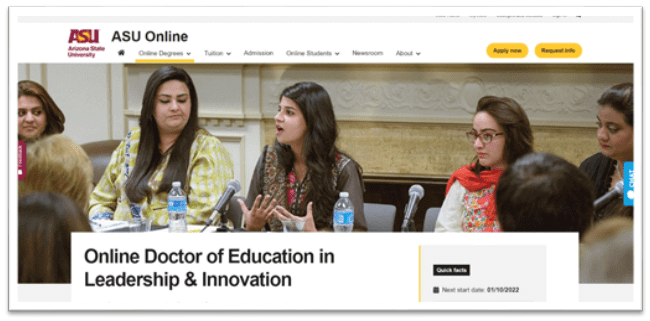
ASU’s program uses action research: you study and improve a problem in your own workplace while you learn. You move through the program in a cohort, with a small “leader-scholar community” of peers and one faculty member for support.
- Credits: 60 (20 classes, each 7.5 to 15 weeks)
- Length: 3 years
- Final project: dissertation, which you defend
- Admission: master’s degree; 3.0 GPA in your master’s and in the last 60 hours of your bachelor’s; a current job in education where you can lead change; admission is competitive
- Tuition: check from ASU’s tuition calculator
- Best for: working educators who want to research their own school or organization
7. Florida State University: EdD in Educational Leadership and Policy

Florida State’s online EdD focuses on putting research into practice in K-12 and higher education leadership. Coursework is asynchronous, so you study on your own schedule, and the cohort meets in person each summer.
- Credits: 69
- Format: online and asynchronous, with a Summer Institute in Tallahassee each June
- Admission: graduate degree (3.5 GPA recommended) and a 3.0 upper-division bachelor’s GPA; GRE required unless you qualify for a waiver, for example with a 3.75 master’s GPA
- Start: summer only; final deadline February 1
- Tuition: $444.26 per credit in-state, $1,075.66 out-of-state (2024-25 rates)
- Best for: Florida residents who want a low-cost public program
8. University of Florida: EdD in Curriculum and Instruction (Teachers, Schools, and Society)

This part-time program is for practicing educators who want to use research to improve teaching in their own schools. It won the Carnegie Project on the Education Doctorate (CPED) Program of the Year award in 2020.
- Credits: 60 minimum; up to 30 credits can transfer toward the doctorate
- Length: 4 years, part-time
- Format: online, with week-long campus institutes in the first and third summers
- Admission: master’s degree and a 3.0 upper-division GPA
- Start: a new cohort begins every other year. The next one starts in summer 2028, with applications open until January 8, 2028
- Best for: teachers and teacher leaders who can plan around the two-year admission cycle
9. Indiana University Bloomington: EdD in Literacy, Culture, and Language Education
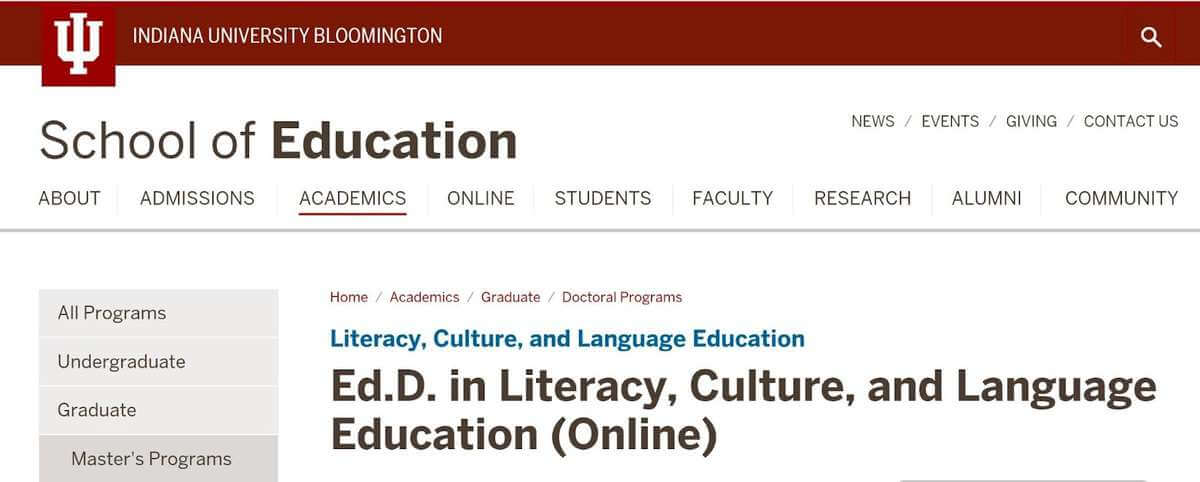
Indiana offers one of the few online EdDs focused on literacy and language teaching. It is also one of the lowest-cost programs on this list, even for students outside Indiana.
- Credits: 60; up to 18 credits can transfer
- Length: coursework typically takes 3 years; up to 7 years allowed
- Admission: master’s degree and a 2.75 bachelor’s GPA; GRE only for applicants without a degree from an accredited U.S. institution
- Deadline: January 15 for a fall start
- Tuition: $581.18 per credit for residents, $688.68 for non-residents, including the distance education fee (2026-27)
- Best for: literacy, ESL, and language educators
10. Fordham University: EdD in Educational Leadership, Administration, and Policy

Fordham’s online EdD is for people already leading in PK-12 schools who want to serve their communities better, especially underserved ones.
- Credits: 50
- Length: about 3 years
- Format: online, with 2 immersions at Fordham’s Westchester campus
- Admission: master’s degree (about a 3.5 graduate GPA) and 3 years of PK-12 leadership experience; GRE or MAT optional
- Best for: current school and district leaders in PK-12
How we chose these online doctoral programs in education
We looked for Doctor of Education programs that a working professional can complete mostly or fully online. Each program on this list:
- is offered by an established, accredited U.S. university
- publishes clear information on credits, format, and admission requirements
- is designed for people who keep working while they study
The list covers a range of prices, specializations, and formats. It is not a numerical ranking, and the right program for you depends on your field, budget, and schedule. Program details change often, so confirm everything on the official program page before you apply.
How much does an online EdD cost?
Tuition for the programs on this list runs from about $30,000 to about $130,000 in total. The gap comes mostly from the per-credit rate: public universities at resident rates and Liberty charge roughly $450 to $700 per credit, while private research universities charge $1,785 to $2,539.
The estimates below multiply the published per-credit rate by the credits you take in the program. They leave out fees, books, and travel to campus, and assume no transfer credits beyond those shown.
|
Program |
Calculation |
Estimated tuition |
|
Florida State (in-state) |
69 credits × $444.26 (2024-25 rate) |
About $30,650 |
|
Liberty (full-time) |
54 credits × $630 |
About $34,020 |
|
Indiana (resident) |
60 credits × $581.18 |
About $34,870 |
|
Indiana (non-resident) |
60 credits × $688.68 |
About $41,320 |
|
Florida State (out-of-state) |
69 credits × $1,075.66 (2024-25 rate) |
About $74,220 |
|
Baylor |
54 credits × $1,785 (2025-26 rate) |
About $96,390 |
|
USC |
43 units × $2,539 |
About $109,180 |
|
Johns Hopkins |
54 credits × $2,315 |
About $125,010 |
|
Vanderbilt |
54 credits × $2,405 (2025-26 rate) |
About $129,870 |
Arizona State, the University of Florida, and Fordham are not shown because we could not confirm a current per-credit rate.
What are the cheapest online EdD programs?
On this list, the lowest-cost options are Florida State for Florida residents, Liberty University, and Indiana University. Indiana stands out for students outside the state, because its non-resident rate is only about $100 more per credit than the resident rate.
Three things can lower your cost further:
- Transfer credits. Indiana accepts up to 18 and Liberty up to 50% of the degree.
- Employer support. Many school districts and universities offer tuition help. Ask your HR office before you apply.
- Military rates. Liberty charges $395 per credit for eligible military students.
For more low-cost options, see our guide to the cheapest online PhD programs.
Online EdD vs. online PhD in education
Both are doctorates in education, but they prepare you for different work. An EdD is a practitioner’s degree: you use research to solve problems in schools and organizations. A PhD in education trains you to produce original research, and usually leads to a career as a professor or researcher.
|
EdD |
PhD in education |
|
|
Main goal |
Lead and improve practice |
Create new research |
|
Typical student |
Working teacher, principal, or administrator |
Future professor or researcher |
|
Final project |
Applied dissertation or capstone on a real workplace problem |
Traditional research dissertation |
|
Study pattern |
Often part-time and online |
Often full-time and on campus |
|
Common careers |
Superintendent, principal, dean, director of learning |
University faculty, research scientist, policy analyst |
All 10 programs on this list are EdDs. If you search for “online PhD education” because you want a doctorate you can earn while working, an EdD is usually the better match. If you want a research career, read our full guide to EdD vs. PhD in education.
Admission requirements for an online doctorate in education
Requirements differ by school, but most programs on this list ask for the following:
- A master’s degree. Nine of the 10 programs require one. USC also offers a longer 60-unit track for applicants with only a bachelor’s degree.
- A minimum GPA. Stated minimums range from 2.75 (Indiana) to about 3.5 (Fordham). Many programs set 3.0.
- Work experience. Several programs ask for 2 to 3 years of professional or leadership experience, and ASU requires a current job in education.
- Written materials. Expect a personal statement, a resume or CV, letters of recommendation, and often a writing sample.
- Test scores, sometimes. Most programs here do not require the GRE. Florida State does unless you qualify for a waiver.
Your statement matters a lot for an EdD, because many programs want you to describe a real “problem of practice” you plan to study. Our guide on whether GPA matters for grad school can help if your grades worry you.
Frequently asked questions
How long does an online EdD take?
Most online EdD programs on this list are designed to take three to four years while you work. Baylor, Arizona State, and Fordham plan for about three years. Johns Hopkins and the University of Florida plan for about four. Part-time study or a slow dissertation can add time, and Indiana allows up to seven years.
What is the cheapest online EdD program?
On this list, Florida State is the least expensive for Florida residents, at roughly $30,650 in tuition. Liberty University (about $34,020) and Indiana University (about $34,870 for residents and $41,320 for non-residents) are the lowest-cost choices for most other students. These figures cover tuition only.
Do online EdD programs require the GRE?
Most do not. Baylor and Liberty do not ask for it, and USC does not accept it at all. Johns Hopkins, Vanderbilt, and Fordham make it optional. Florida State requires the GRE unless you meet its waiver rules.
Is an online doctorate in education respected by employers?
An online EdD from an accredited university is the same degree as the on-campus version. Arizona State, for example, states that its diplomas and transcripts do not say “online.” What employers usually care about is the university’s accreditation and reputation, and what you can do with your training.
Do I need a master’s degree to apply for an EdD?
Usually, yes. Nine of the 10 programs here require a master’s degree. USC is the exception: it offers a 60-unit track for applicants with a bachelor’s degree and enough work experience.
Can I work full-time while earning an online EdD?
Yes. These programs are built for working professionals, and several expect you to use your own workplace for your research. Check the live class times and campus visits first. Vanderbilt, Baylor, Florida State, the University of Florida, and Fordham all require some travel.
Next steps
An online EdD is a big commitment of time and money, so shortlist two or three programs that match your field, your budget, and how much travel you can manage. Then confirm the details on each official program page, because deadlines and tuition change every year.
When you are ready to go further:
- See real admissions outcomes. Search education admissions results on The GradCafe to see when decisions go out and what other applicants report. These results are self-reported and are not official statistics.
- Ask people who have applied. Join the conversation in The GradCafe forum.
- Keep comparing. Read our round-up of the top online PhD programs, or start with our master’s in education guide if you do not have a master’s yet.

Lisa is a full-time writer specializing in career advice, further education, and personal development. She works from all over the world, and when not writing you'll find her hiking, practicing yoga, or enjoying a glass of Malbec.